Contact Sales Team

This article looks at two important components in every drone: the battery, and the quartz crystals.
- The battery sets how long the drone can fly, how much it can carry, and how cold a climate it can work in.
- Quartz crystals are used as timing references for digital electronics. They sit on the flight controller, the GNSS module, the radio, and the camera and provide the clock that each of these subsystems needs to work correctly. Without a stable clock, the autopilot cannot run its control loop, the GNSS receiver cannot decode the satellite signal, and the video link cannot stay in sync.
Telcona works with a manufacturer for each of these two component classes: Honcell for lithium batteries, and Hong Kong Crystal for quartz crystals and oscillators.
What is a drone
A drone, or unmanned aerial vehicle (UAV), is an aircraft that flies without a pilot on board. It is controlled either by a remote operator on the ground or by an onboard autopilot that runs a pre-programmed mission. Drones come in many sizes. The smallest consumer quadcopters weigh under 250 grams. Industrial multirotors weigh several kilograms and can carry spraying tanks or thermal cameras. Fixed-wing drones are larger and used for long flights over wide areas.
Applications
Drones are used in many different roles, for example:
- Aerial photography and cinematography — Handheld and professional drones used for visual capture.
- Mapping, photogrammetry, and surveying — Drones with imaging payloads and GNSS-tagged data collection.
- Inspection — Power lines, wind turbines, pipelines, bridges, and building façades.
- Agricultural — Crop monitoring and spraying drones.
- Exploration — Operation in remote or hazardous environments.
- Delivery and logistics — Short-range package and medical-sample transport.
- General civilian and commercial use — Hobby, educational, and entry-level professional applications.
Each of these places a different priority on the same two underlying subsystems: the battery pack that powers the flight, and the quartz references that synchronise its electronics.
Main components
Whatever the size and type, every modern drone contains the same core subsystems.
- Airframe: The structural frame of the drone. It holds the motors in their fixed positions and houses other components.
- Brushless motors, ESCs, and propellers: Together these make up the propulsion system. The flight controller commands each motor's torque; the ESC (Electronic Speed Controller) drives the motor; the propeller converts rotation into thrust.
- Flight controller: An autopilot MCU.
- GNSS module: The position and satellite time.
- RF link: The radio connection between the drone and the operator.
- Camera and gimbal: The payload. The image sensor needs a pixel clock to read out lines and frames. The gimbal MCU stabilises the camera mechanically against the airframe's motion. Both run on their own clocks.
- Battery pack: Propulsion energy source. On most drones, this is the largest electronic component by volume and weight. It sets how long the drone can fly, how much it can carry, how fast it can climb, and the temperatures at which it can operate.
Now let's take a close look at two of these subsystems: the battery, and the quartz crystals.
Batteries
The battery is one of the most important choices in drone design. The chemistry, cell format, and pack architecture together determine how long the drone flies, how much it can lift, how cold a climate it works in, and how many flights it survives before being retired. Honcell, one of Telcona's battery partners, develops and manufactures lithium-based cells and packs for drone applications. Their coverage includes aerial photography drones, mapping drones, exploration drones, inspection drones, agricultural drones, and delivery drones.
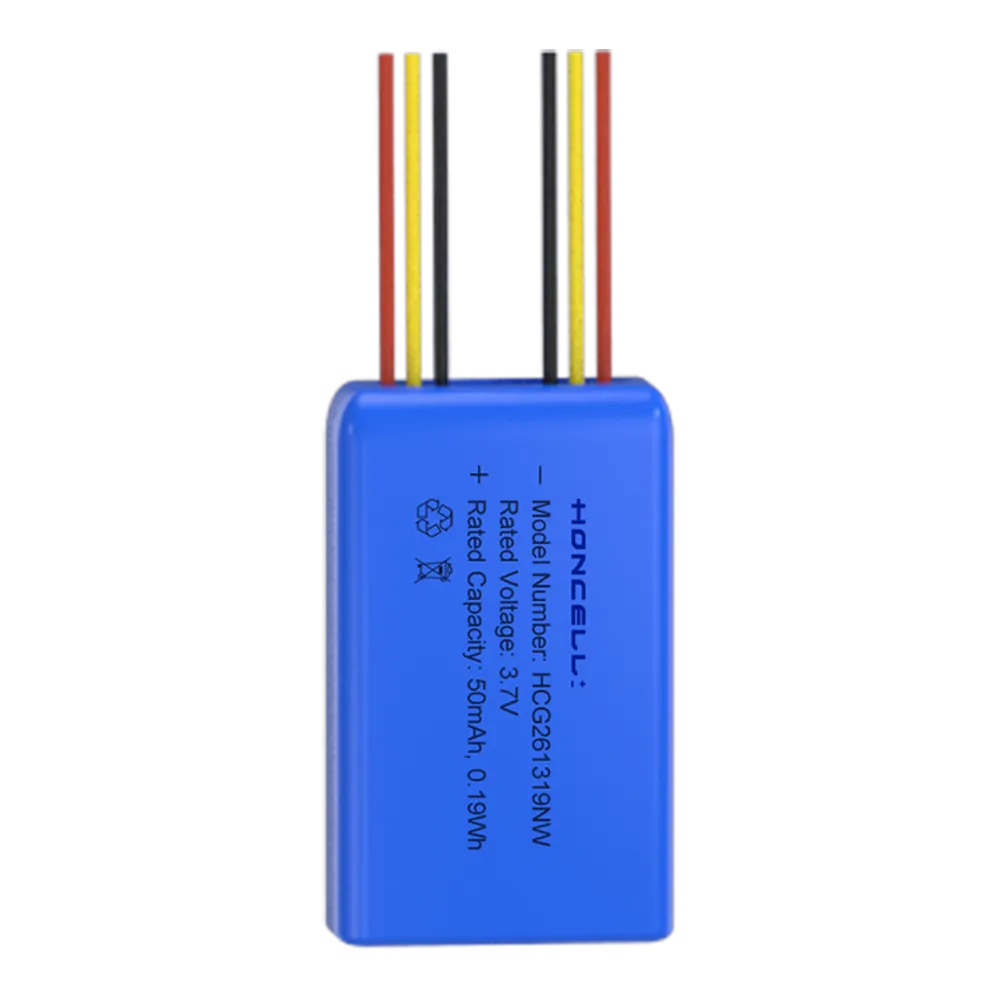
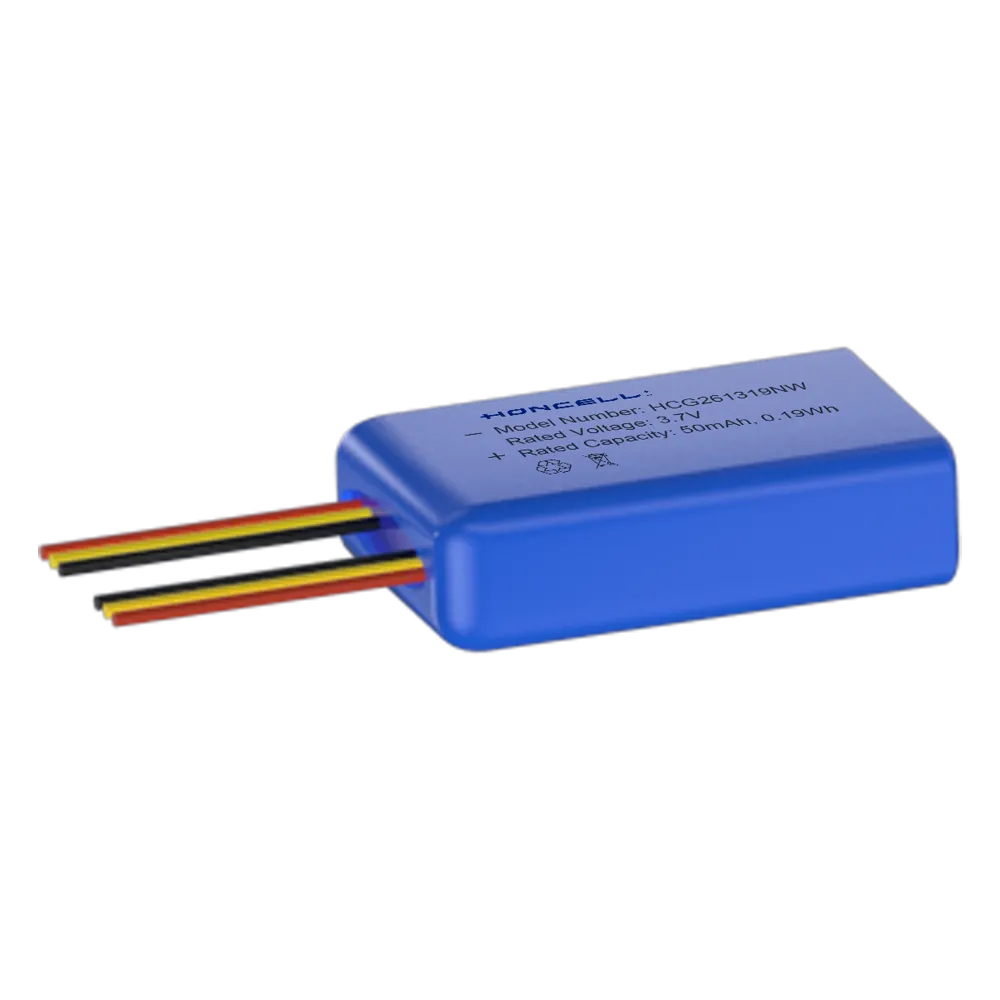
The table below shows a representative selection of Honcell's drone-focused models, from 50 mAh single-cell auxiliary packs up to a 22.2 V 8000 mAh 6S2P pack:
| Model No. | Voltage [V] | Capacity [mAh] | Max. Discharge [C] | Peak Discharge [C] |
|---|---|---|---|---|
| HCG261319NW | 3.7 | 50 | 1.0 | 35 |
| HCG431433NSP | 3.7 | 100 | 15 | 30 |
| HCG431433SPNZC | 3.7 | 100 | 15 | 30 |
| HCG801330NZC | 3.7 | 200 | 15 | 35 |
| HCG502003ZC-2S1P | 7.4 | 270 | 10 | n/a |
| HCG471444HNZC-2S1P | 7.4 | 300 | 0.5 | 6.67 |
| HCG852025FC-2S1P | 7.4 | 300 | 6.7 | 13.3 |
| HCG452340ZC-3S1P | 11.1 | 420 | 5 | 10 |
| HCG123035ZC-2S1P | 7.4 | 1050 | 2.86 | 10 |
| HCG9043118BZC-4S1P | 14.8 | 5400 | 5 | 10 |
| HCG6843129ZC-6S2P | 22.2 | 8000 | 5 | 10 |
The same product line covers most drone designs. For requirements outside the catalogue, such as unusual form factors, low-temperature performance, or specific BMS configurations, Honcell can also design and deliver custom packs. This makes them useful for both prototype work and series production.
Quartz crystals and oscillators
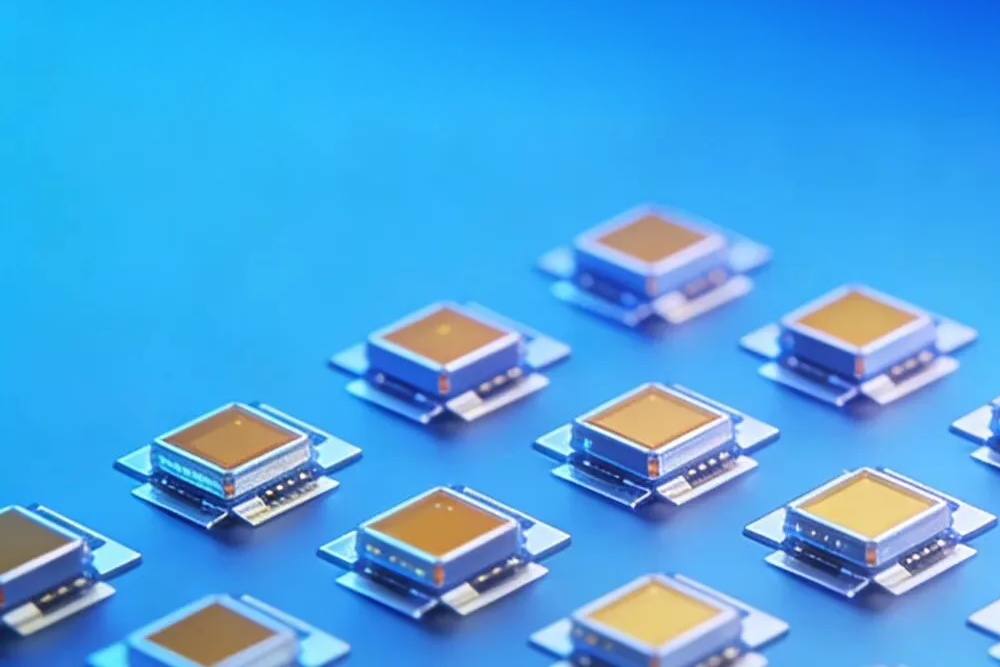
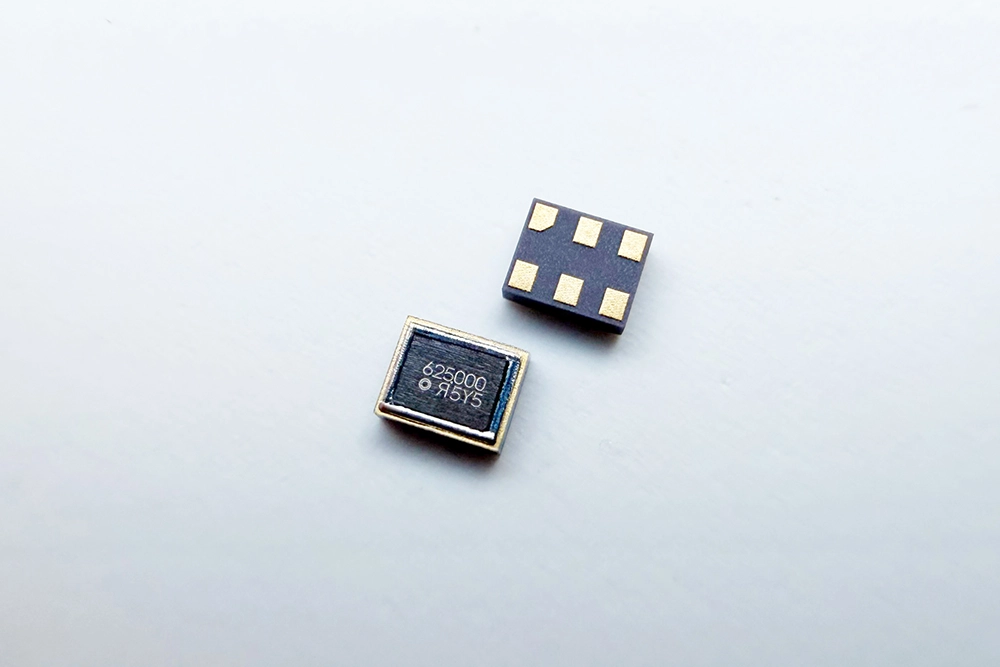
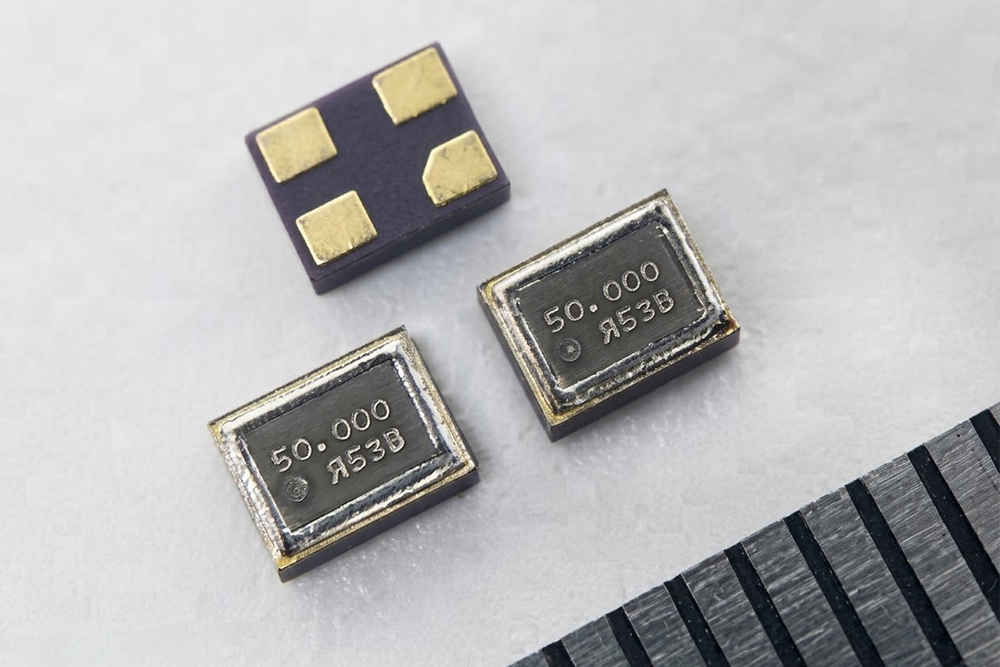
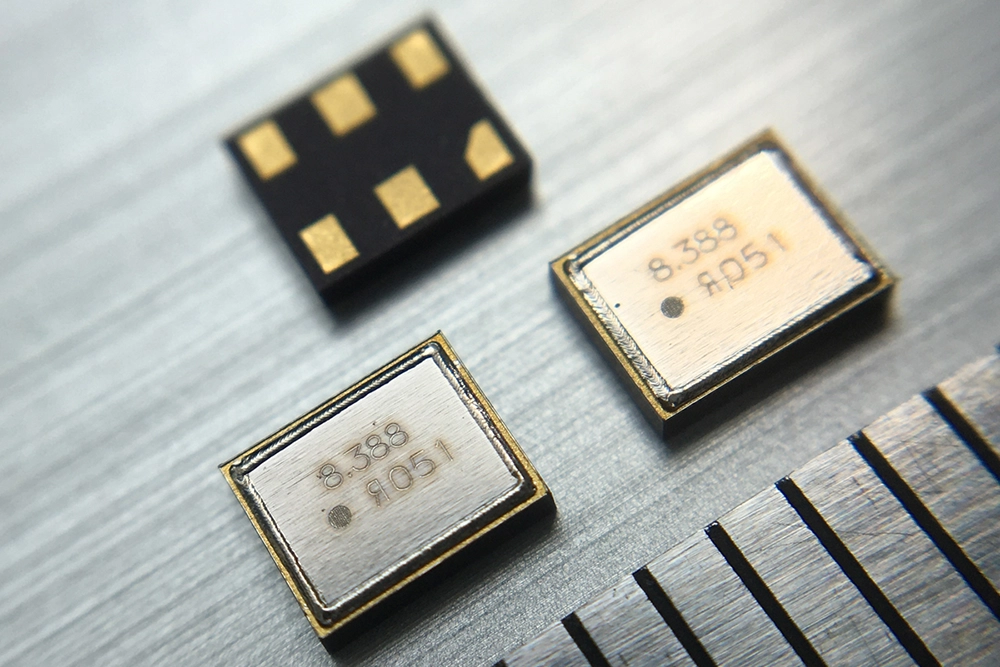
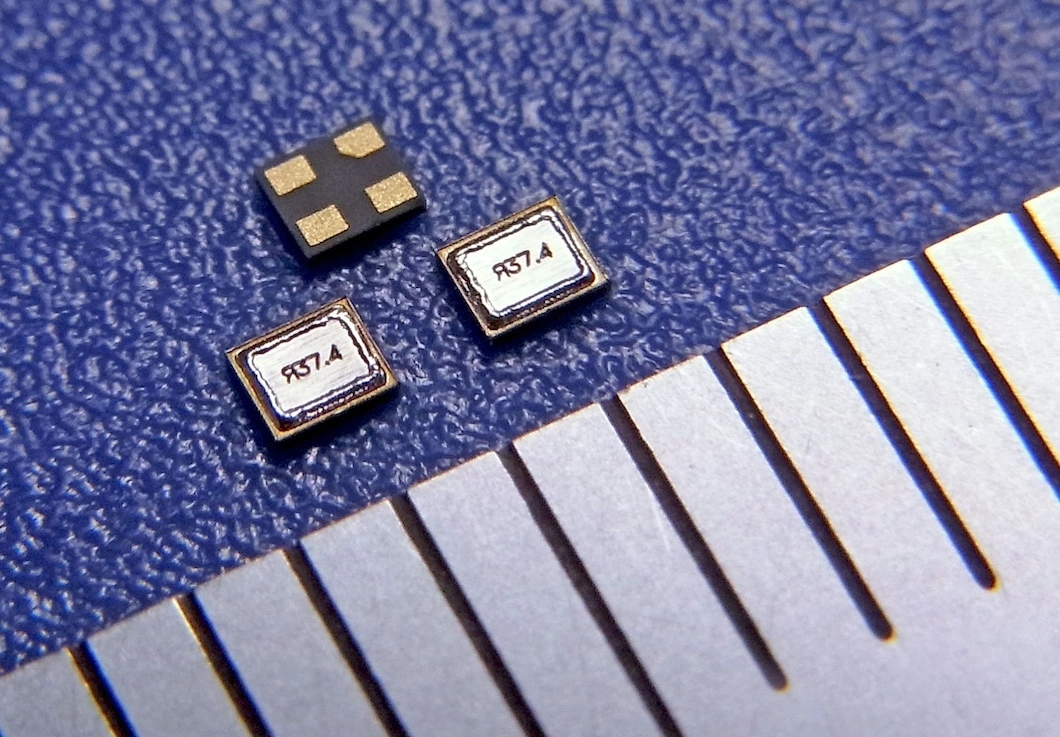
Every digital subsystem in a drone needs a clock. The flight controller, the GNSS receiver, the radio modem, the video transmitter, the image sensor, and the gimbal MCU all run from their own quartz reference. The quality of that clock directly affects how the subsystem behaves. Hong Kong Crystal (Hong Kong X'tals Limited) supplies quartz crystal resonators and oscillators with the frequencies matched to drone subsystem requirements.
- Flight controller MCU — Drone flight controllers are built around microcontrollers clocked from the standard MHz-range frequencies like 16, 24, 32, 40, and 48 MHz. They are supplied in ceramic SMD-4 packages: 1612SX, 2016SX, and 3225SX. 8 pF load capacitance is the standard offering.
- GNSS module — GNSS receivers all need a stable local oscillator to demodulate the satellite signal and to maintain coherence between fixes. For drone GNSS, the typical choice is 26 MHz, available in the same 1612SX / 2016SX / 3225SX ceramic SMD-4 families.
- RF communication link — Whether the drone uses Wi-Fi, Bluetooth, or LTE, the radio's PHY layer is referenced to a crystal with a frequency list covering 25, 26, 32, 38.4, 40, 48, and 52 MHz, available in the same ceramic SMD-4 resonator packages. For designs that need a packaged frequency source instead of a discrete crystal, the 2016XO, 2520XO, and 3225XO crystal oscillator series provide a clock with ±50 ppm frequency stability on a 3.3 V supply.
- Camera and gimbal — Image sensors typically clock at a small set of standard frequencies, usually 24 MHz or 27.12 MHz. Crystal oscillators in the 2016XO, 2520XO, and 3225XO ceramic SMD-4 families cover this range.
Both suppliers through Telcona
The battery and the quartz crystals are both important component choices in a drone bill of materials. One handles the high-power propulsion energy. The other handles low-power timing references. Both must survive the same vibration, temperature, and shock environment as the rest of the aircraft.
Through Telcona, both suppliers are available under a single European contract: Honcell for lithium-based drone batteries, and Hong Kong Crystal for quartz resonators and oscillators.
👉 For sample requests, custom pack design, frequency selection, or full BOM analysis on a drone programme, contact Telcona at +41 44 861 02 40, or send us a message.