Contact Sales Team
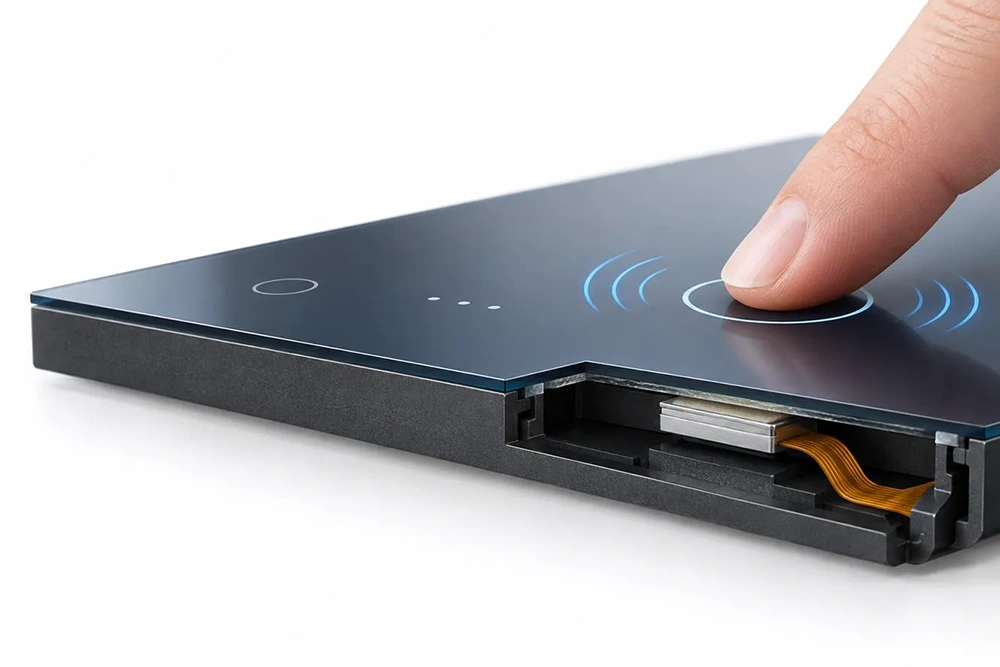
JL World's SPP03A piezoelectric actuator for compact touch interfaces
Unlike mechanical buttons, touch controls on flat glass or plastic panels do not inherently provide a tactile click. A haptic actuator adds a brief vibration to confirm that the input has been registered, so users can feel the response without looking at a display.
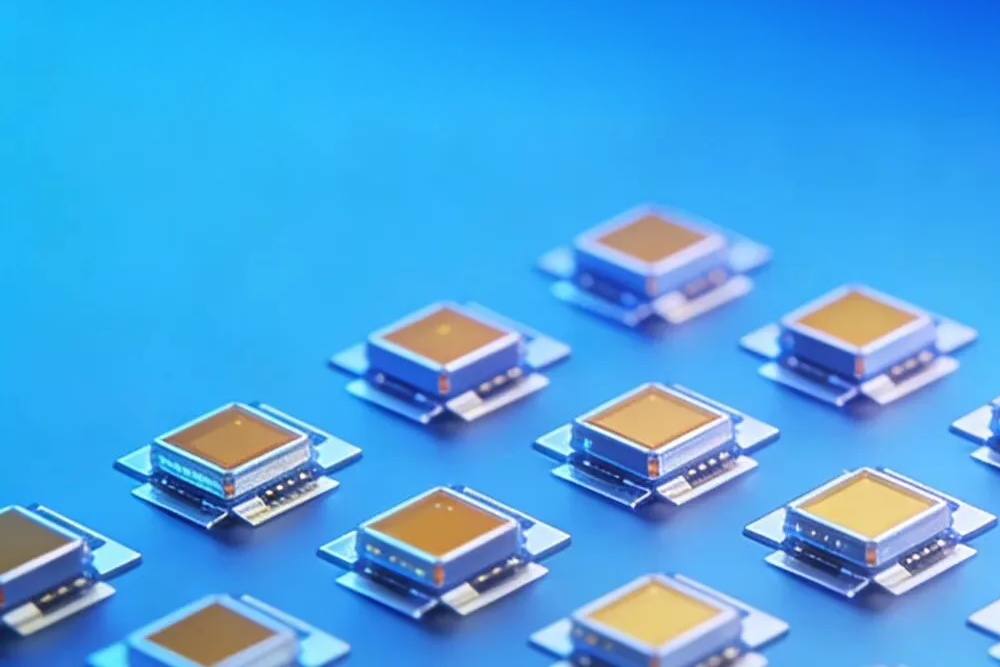
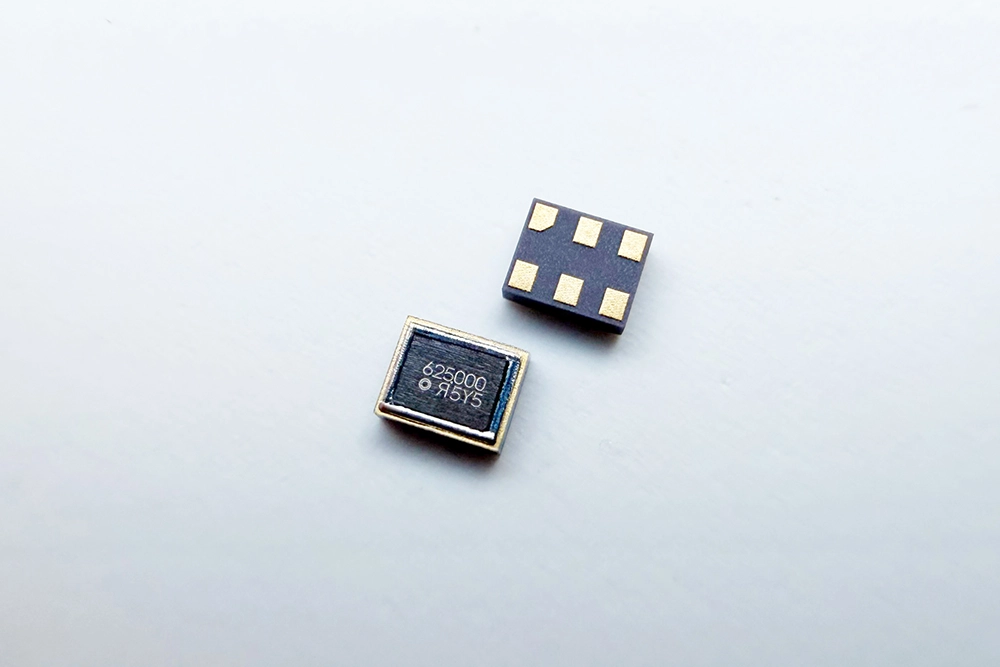
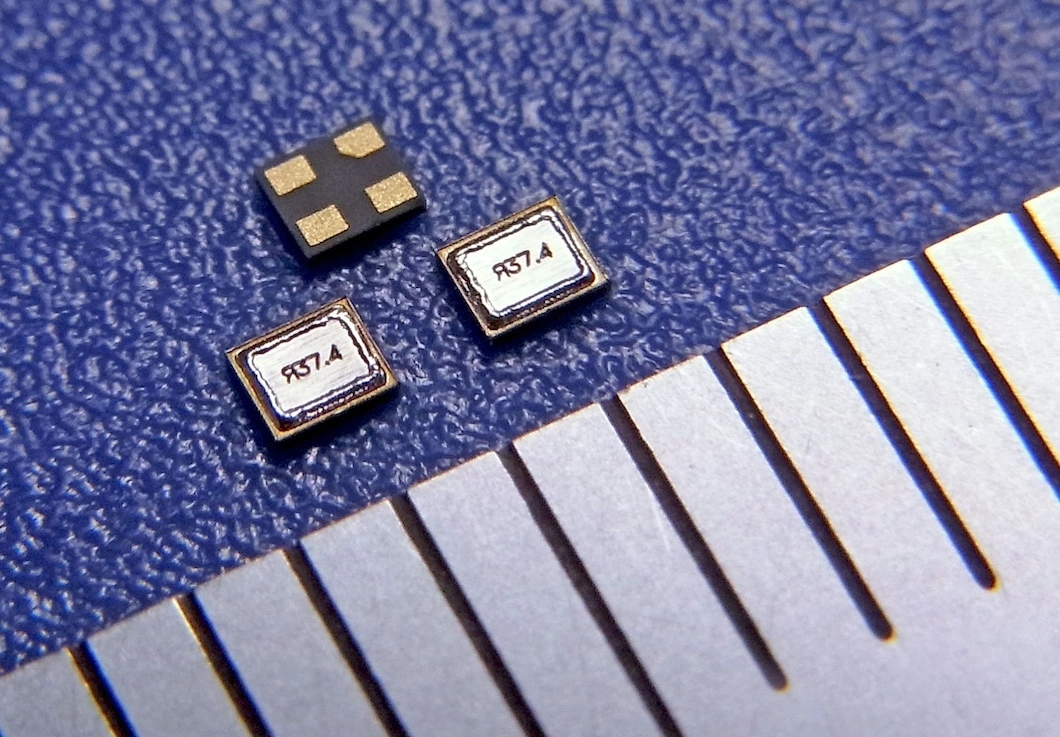
JL World's SoniCrest SPP03A measures 6 x 3.75 mm and weighs approximately 0.1 g. Mounted behind a touch surface, it converts a drive waveform into mechanical motion.
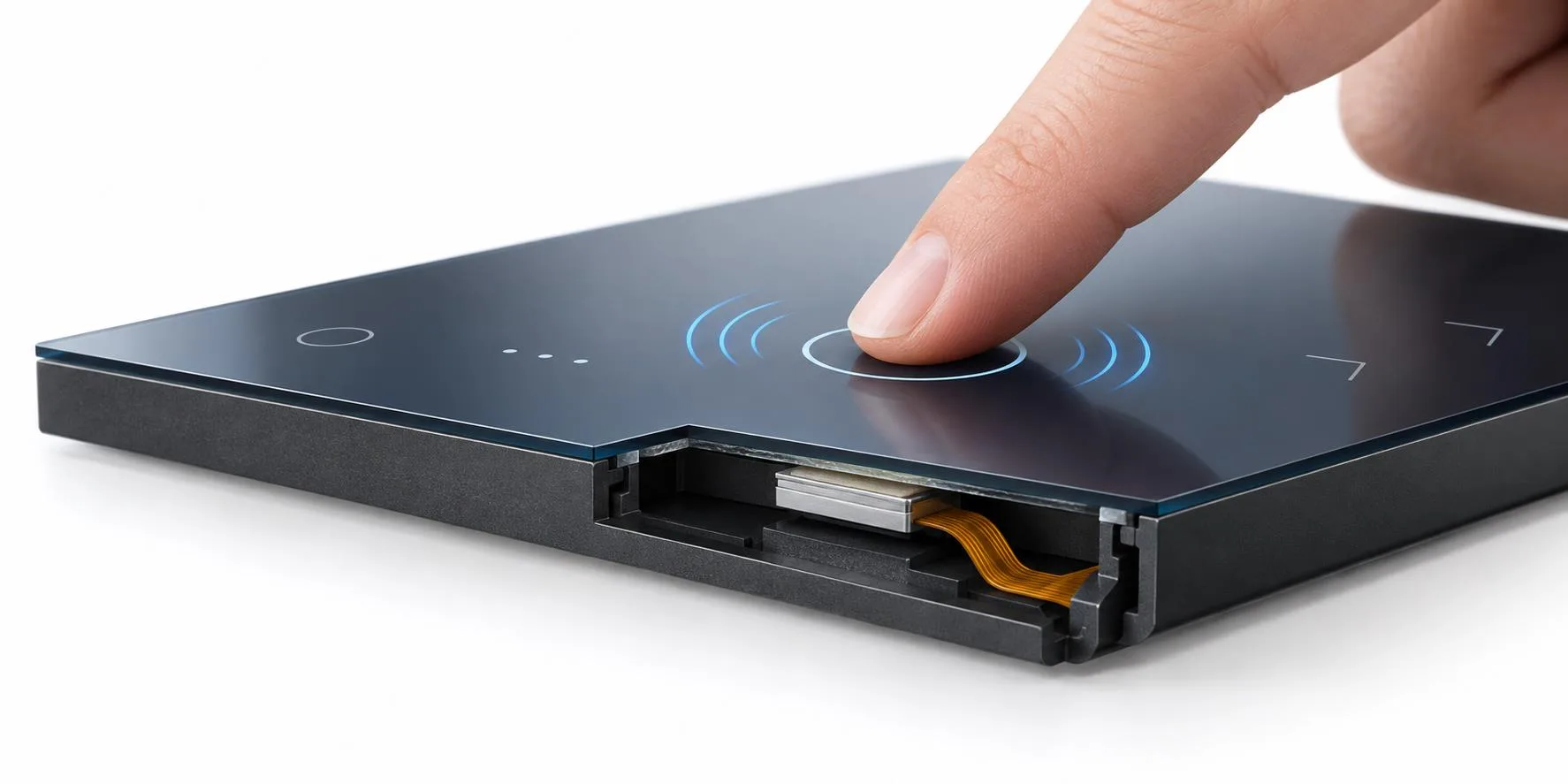
Conceptual illustration of a piezoelectric actuator mounted beneath a flat touch panel.
From an electrical pulse to a tactile click
The SPP03A uses the reverse piezoelectric effect: an applied electric field produces a small dimensional change in its ceramic, bending the structure. A touch controller detects the input, the MCU selects an effect, and an external piezo driver applies the waveform. The bond transfers motion into the panel.
The SPP03A is specified as an actuator, not a touch sensor. A separate piezo sensing path could use a charge amplifier or high-input-impedance voltage front end, but self-sensing operation is not specified for this part.
SPP03A at a glance
| Parameter | SPP03A specification |
|---|---|
| Actuator size | 6 x 3.75 mm; thickness 1.1 ±0.15 mm |
| Weight | Approximately 0.1 g |
| Operating voltage | -10 V to +60 V |
| Capacitance | 170 ±20% nF at 1 kHz, 1 Vrms |
| Acceleration | 1.4 to 1.5 g peak-to-peak under the specified 20 g-load, 0 to 60 V unipolar, 200 Hz pulse test |
| Operating temperature | -40 to +85 °C |
Where the SPP03A fits
Potential applications include medical controls, consumer touchpads, precision instruments and smooth appliance panels. In each case, tactile confirmation can complement a flat interface. Medical qualification, cleaning resistance and ingress protection must be considered.
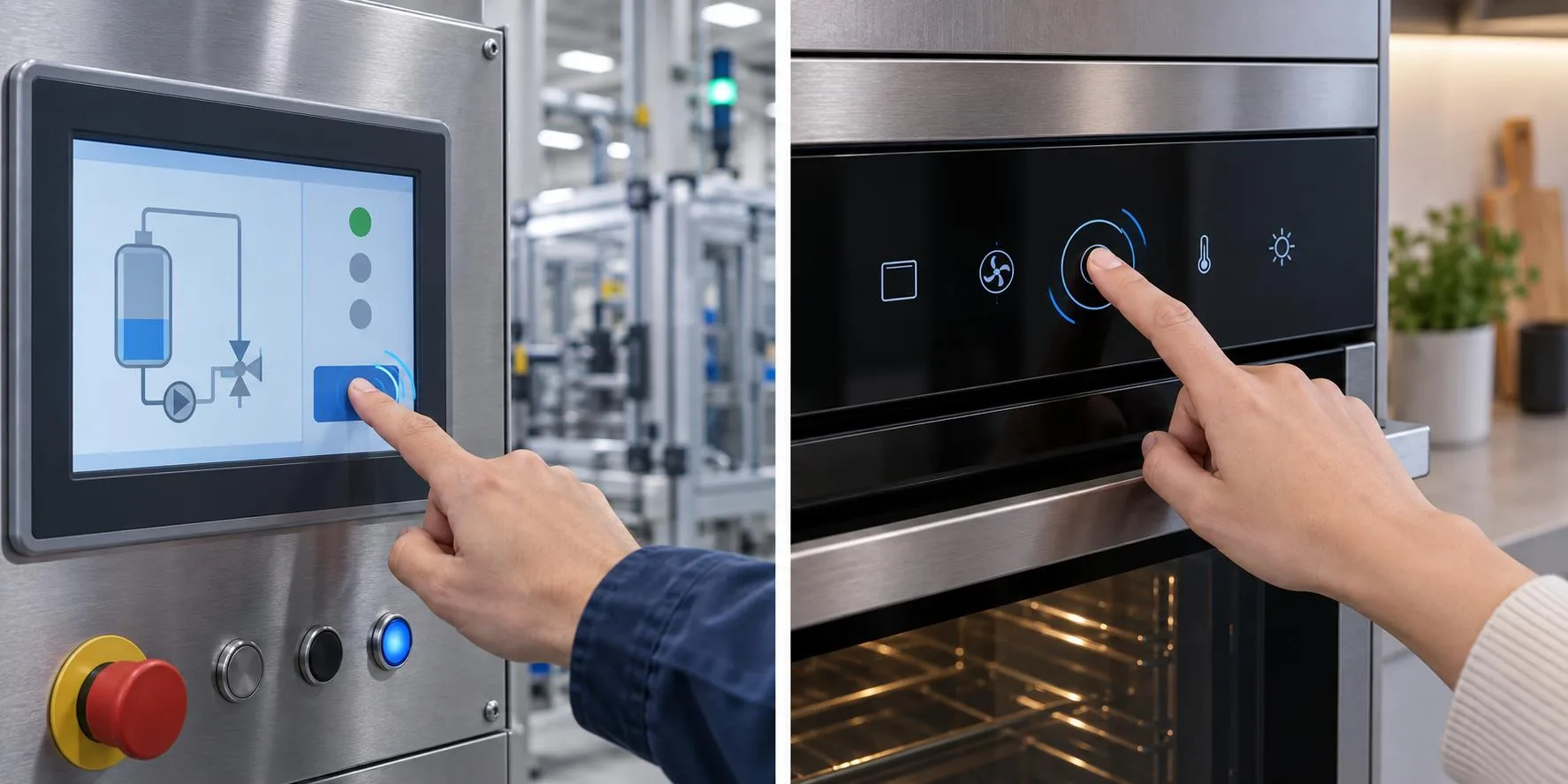
Conceptual examples of haptic feedback in an industrial HMI panel and a home-appliance touch control.
Selection starts with the application, available space, mounting method and electrical requirements. For hardware and mechanical engineers, the following guidelines might be useful when integrating a haptic actuator into a device:
- Control adhesive thickness, orientation and actuator location: the bond must transfer motion without excessive damping or ceramic stress.
- Check driver voltage, source-and-sink current and slew rate.
- Validate retriggering, acoustic noise, finger loading and environmental exposure on the final assembly.
The tactile response should then be evaluated in the assembled product.
Reliability coverage
The specification lists 96-hour operating-life testing, 240-hour high- and low-temperature exposures, ten thermal-shock cycles and 100 hours of humidity exposure.
The stated 180 Vp-p life-test condition is a stress test, not the operating rating: normal drive remains -10 V to +60 V.
Where Telcona fits
Telcona AG supports component selection by reviewing the application, available installation space, mounting method, electrical requirements and desired tactile response. Together with JL World, Telcona helps identify suitable components and provides engineering samples for evaluation.
For sample availability, lead times and technical support, contact Telcona. Our technical and commercial teams support projects from prototyping through sourcing and series production.